
The best employee engagement software depends on what you need it to do. For hearing honest feedback and acting on it quickly, Hoogly is our pick. For long-running benchmarks across a large workforce, Culture Amp. For engagement bundled with performance reviews, Lattice or Leapsome. For weekly check-ins, 15Five. Viva Glint and Workday Peakon suit Microsoft and Workday shops, and Qualtrics and Perceptyx suit research-heavy enterprises.
We built Hoogly and we rank it first. To ground the rest, we read around 750 written customer reviews, plus practitioner discussions online, and report what each platform’s users like and what they complain about. Every quote carries its date.
The short version
| Rank | Platform | Best for | What reviewers like | What reviewers complain about |
|---|---|---|---|---|
| 1 | Hoogly | Honest feedback and fast action in mid-sized teams | Feeling heard, anonymity people believe, feedback that turns into action (customers) | Not a performance suite |
| 2 | Culture Amp | Benchmarks and survey science at scale | Benchmarks, support | Renewal pricing, admin navigation, rigid structure |
| 3 | Lattice | Engagement alongside performance and pay | Reviews and 1:1s | Cost for the bundle, limited survey analysis, anonymity worries |
| 4 | Leapsome | One tool for reviews, goals, learning and engagement | Interface, customisation | Admin setup time, lingering bugs, thin learning module |
| 5 | 15Five | Weekly check-in cultures | Weekly check-ins, Slack integration | Repetitive questions, billing disputes, rigid survey design |
| 6 | Viva Glint | Microsoft-first organisations | Dashboards | Support after the Microsoft merger, interface (limited reviews) |
| 7 | Workday Peakon | Workday customers with large teams | Easy rollout | Anonymity in small teams, notification volume (limited reviews) |
| 8 | Qualtrics Employee Experience | Customisable research-grade surveys | Survey design, analytics | Steep learning curve, self-serve model, being oversold |
| 9 | Perceptyx | Consultant-supported programmes | Services team | Narrow feature set per one reviewer (very limited reviews) |
The ranking reflects one criterion: how well each platform helps a Head of People hear the truth and do something about it. If your priority is a full performance suite or enterprise research tooling, the order changes, and how to choose explains how.
What is employee engagement software?
Employee engagement software helps organisations measure how people feel about work, understand why, and act on what they hear. Most platforms combine surveys or pulse checks, an analytics layer, and some form of action planning. Many also bundle performance reviews, goals, 1:1s or learning. We use one test throughout this article, which we call the Listen, Understand, Act loop:
- Listen. Do people trust the tool enough to be honest?
- Understand. Does the analysis explain why, or only report a score?
- Act. Does a manager leave with something specific to do?
A platform that is strong on the first step and weak on the third produces a lot of data and very little change.
How we compared them
We compared the platforms on what customers write. For each one we read written reviews on G2 and Capterra at both ends of the scale, 4 to 5 stars for what people like and 1 to 3 stars for what frustrates them, and searched r/humanresources for what practitioners say when asked for a recommendation.
1. Hoogly: best for honest feedback and fast action
Best for: Heads of People at mid-sized companies who want honest feedback and a clear next step.
Hoogly replaces the survey form with a private, one-to-one conversation. Each person chats with Venn, our AI coach, picks a pseudonym, and can skip any question or end the conversation whenever they like. Leaders never see individual comments. They see themes, and only once at least five people from a team have responded.
That design gives Heads of People three things.
Anonymity people believe. Hoogly builds its privacy model into the product: pseudonyms, a five-response minimum, no downloadable verbatim comments, and a commitment that your company’s data is never used to train our AI models.
Questions that stay fresh. A conversation adapts to what the person has just said, so the follow-up is about their situation rather than the next item on a list.
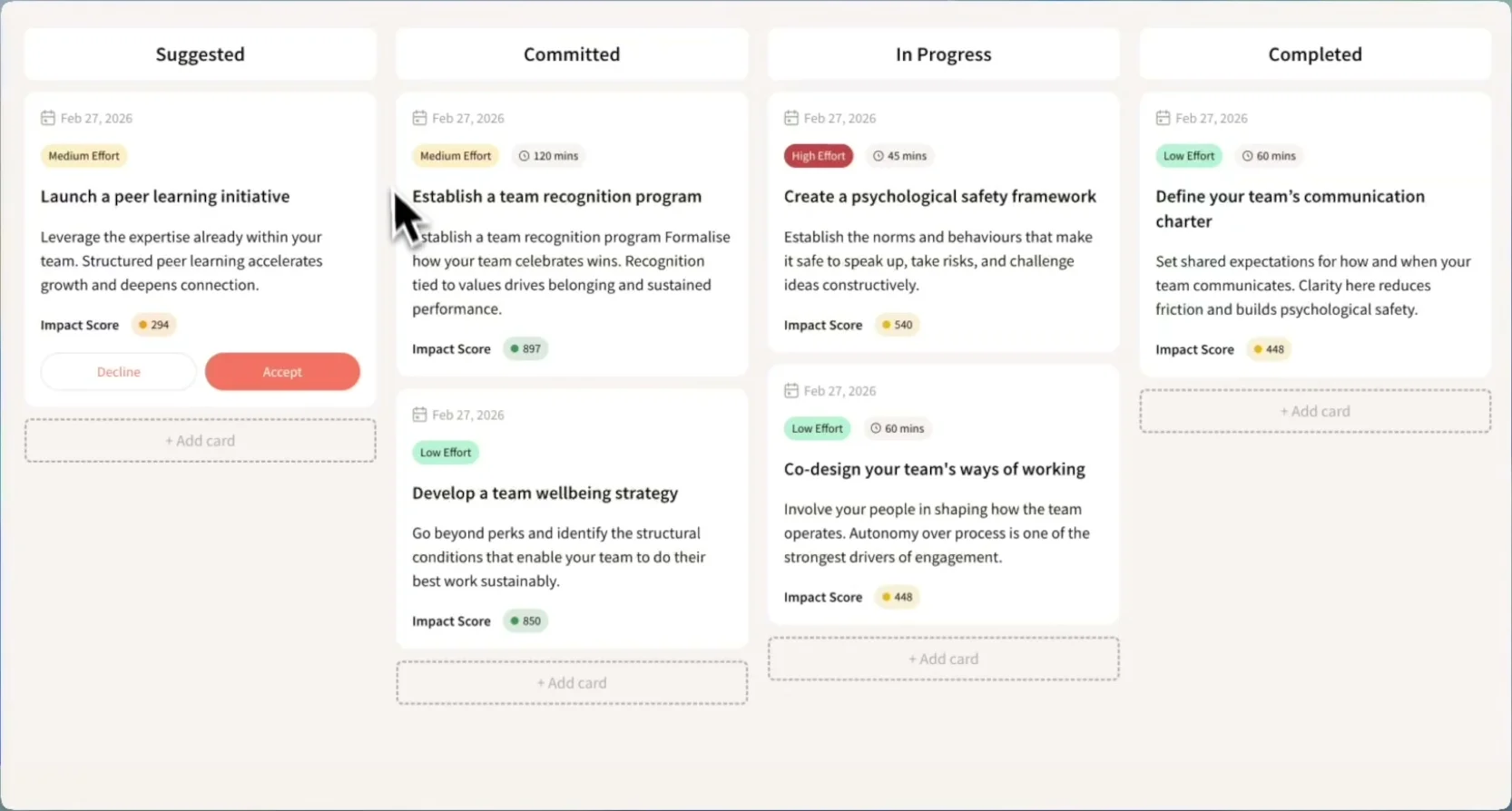
Insight that turns into action. Hoogly turns the themes from your team’s conversations into a personalised action plan on a simple board: suggested, committed, in progress, completed. Each suggested action carries an effort level, an estimated time commitment and an impact score, so a manager can pick the two things worth doing this month.
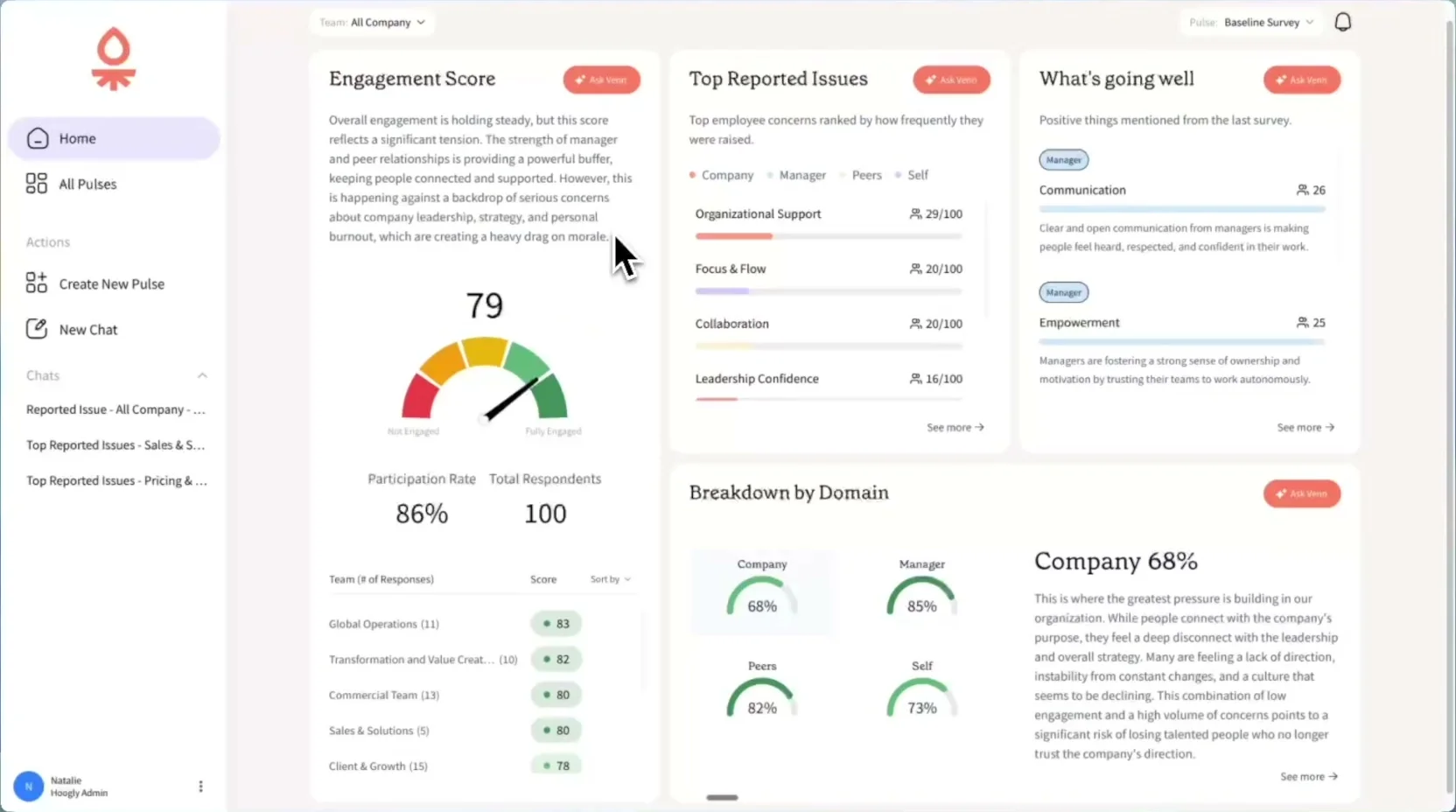
Hoogly connects to Slack and Microsoft Teams for Pulse reminders, supports single sign-on, and can be set up with a Customer Success Manager or on your own. Insights appear once a Pulse closes and the analysis has run. Pilot customers also get access to our Chief Culture Officer, Anitta Krishan, who has scaled culture at TikTok, Grab and Trivago.
What customers like. Three things come up again and again: the conversation makes people feel heard, the anonymity feels real, and the feedback turns into action. These are quotes customers have given us directly.
Liana Mawston has spent more than eight years leading People at Athena Home Loans, first as Chief People & Community and now as Chief of People, Marketing and Corporate Affairs. Before Athena she spent nearly five years at National Australia Bank, as General Manager of Customer Journeys and Program Director of its NPS Transformation. Her career has been spent on the question this article is about: how an organisation hears the people it serves, and whether it acts on what it hears.
“We have seen in practice a culture of listening and quickly responding to feedback and questions from the whole Hoogly team. This is a real demonstration that you live out what is the core proposition of the platform not only in the product but also in your everyday customer interactions!”
Liana Mawston, Chief of People, Marketing and Corporate Affairs, Athena Home Loans
On the anonymity problem in particular, Liana said in her video testimonial that with Hoogly “an employee is actually just having a conversation about their day … people’s verbatim are also not giving them away. And so the sense of real anonymity is there.” You can read how Athena uses it in the Athena case study.
Jenny McMaster, Head of Operations at Digital Agriculture Services, works with a technical team of engineers and data scientists:
“Hoogly’s conversational style really made the team feel like they were being heard. We got much more valuable information rather than just checking boxes or giving a rating.”
Jenny McMaster, Head of Operations, Digital Agriculture Services
She added that DAS’s head of engineering, who is not easily impressed by technology or AI, called it one of the best uses of AI in practice that they had seen. See the Digital Agriculture Services case study.
Three more customers:
“Hoogly is a complete game changer, when it comes to employee engagement.”
Hassanah Rudd, CPO at Hark Medical, formerly Global Head of Workforce Planning at Canva
“[Hoogly] helps us better understand what’s going on and turn feedback into real action. It already feels like a step forward for how we support our people.”
Christina Werakso, Brand, Marketing & Communications, University of Wollongong
“Hoogly enables deeper listening and engagement through personal, AI-led conversations. It’s exactly what a growing team needs to build a high-performance culture.”
David Burt, Director of Entrepreneurship, UNSW
Where Hoogly is not the right fit. We are not a performance review or OKR platform, so if you want appraisals, goals and compensation in one tool, look at Lattice or Leapsome.
2. Culture Amp: best for benchmarks at scale
Best for: larger organisations that want research-backed surveys and industry benchmarks.
What reviewers like. Benchmarking is the main draw, along with support from the customer team and quick survey setup.
What reviewers complain about.
- Cost and value. A reviewer in September 2026 wrote that “they haven’t made many updates to their product over the past few years, yet they keep raising the costs at renewal”. Another, in August 2024, said “CultureAmp is pricey” for “just using it as a survey tool four times a year”.
- Admin experience. A reviewer in October 2025 wrote that “things aren’t always where you expect them to be” for administrators. Another, in August 2024, described a company that grew from 100 to over 400 staff and found the platform “increasingly challenging to utilize”.
- Rigidity. A practitioner who had used both Culture Amp and Lattice described Culture Amp as “a lot more “baked” ie there’s only one way to do things”. A reviewer from 2023 said the rating scales “could not be interpreted without additional information, which allowed managers to gloss over problems raised”.
Choose Culture Amp if you are a large organisation, you value long-running benchmarks, and you have a dedicated team to administer it.
3. Lattice: best for engagement bundled with performance
Best for: companies that want engagement surveys alongside performance reviews, goals and compensation.
What reviewers like. The review module and 1:1s, which reviewers describe as easy to use. A few also like the AI note summaries and the anonymous company-wide questions.
What reviewers complain about.
- Survey depth. A reviewer in October 2025 wrote that “the survey analysis tools provided are extremely limited, making it difficult to gain deeper insights”. Someone who moved from Culture Amp to Lattice said the engagement tool “was lagging behind Culture Amp but loved everything else about it”.
- Anonymity worries. Another reviewer in October 2025 reported “employee concerns about anonymity of surveys and goals”, and a third in July 2026 said shared 1:1 notes can feel “like a performance audit tool rather than a safe space”.
- Price for the package. A commenter at an 800-person company wrote that the quote “was wild for what’s essentially reviews + OKRs + engagement surveys”, and chose Peoplebox instead. Another, at 2,000 staff, put the base price at around $225k, rising to $384k with a second module; a third said you can negotiate discounts at seat thresholds.
- Contract terms and strategy. A reviewer in June 2025 described a 45-day cancellation notice that caught their organisation during a budget squeeze. In a November 2025 online discussion, HR professionals discussed reports that Lattice is winding down its HRIS and payroll modules, and a reviewer in June 2025 had called the HRIS “issue after issue”. It is worth asking any suite vendor which modules are core.
Choose Lattice if performance, goals and compensation are the main job and engagement is a useful extra.
4. Leapsome: best for an all-in-one people platform
Best for: teams that want reviews, goals, learning and engagement in one place and have the admin capacity to configure it.
What reviewers like. A clean interface, structured review conversations, and more customisation than some alternatives.
What reviewers complain about.
- Admin load. A reviewer in December 2024 flagged that “initial setup and customization might require significant time and effort, especially for smaller HR teams”. A reviewer in January 2025 said “it takes a while to do the initial setup”.
- Bugs and translation. In December 2024 a reviewer described “some bugs that take a long time to fix, translation errors in the application in German” and called it “really difficult for a relatively expensive tool”.
- Secondary modules. A reviewer in January 2026 said “Leapsome’s LMS leaves a lot to be desired”.
- Visible peer feedback. Another reviewer said peer assessments “often end up being just a place to write positive things about other people”, because the subject can see who wrote what.
Choose Leapsome if you want a configurable suite and can invest time in setup.
5. 15Five: best for weekly check-in cultures
Best for: organisations where managers will genuinely run weekly check-ins.
What reviewers like. Weekly check-ins, goal tracking and the Slack integration. One practitioner adds a condition: “your company really needs to buy in for it to work”.
What reviewers complain about.
- Repetition. A reviewer in February 2025 who ran twice-monthly surveys said “the questions begin to become repetitive over time. This caused a sharp decrease in engagement scores after 7/8 months.”
- Billing and contracts. Reviewers in 2023 described a renewal where 15Five “continued to try to charge us for the additional seats” after layoffs cut headcount by about 40%, and a subscription you “can’t cancel … yourself”. A reviewer in July 2025 said the company was “unwilling to provide any refund despite not using the product for a year”. Worth reading your contract against.
- Rigidity and reliability. A reviewer in April 2026 called survey and review design “very rigid”. In July 2026 another reported a system error in a custom engagement survey that left “eleven responses … registered as blank”, with the data unrecoverable.
Choose 15Five if your managers will use the weekly rhythm and you want it tied to goals and performance.
6. Viva Glint: best for Microsoft-first organisations
Best for: companies already standardised on Microsoft that want a listening tool inside that ecosystem.
What reviewers like. Clear dashboards and quick surveys.
What reviewers complain about. We found only three low-rated written reviews, so lean on practitioner discussions. In a January 2025 thread, a former Glint customer said they declined to move to the Microsoft version “because the UI is not enticing and the customer service leading to the migration was awful”. Another commenter said “time to reply was long and level of support was low”.
Choose Viva Glint if you run on Microsoft and your leadership is more likely to back a Microsoft product than anything else.
7. Workday Peakon: best for Workday customers with large teams
Best for: organisations on Workday with teams big enough that small-group anonymity is not a concern.
What reviewers like. Easy rollout, and managers can reply to comments. Some reviewers also value the benchmarking.
What reviewers complain about. We found only five low-rated written reviews, so treat these as signals rather than patterns. A reviewer in October 2025 said “I also WISH we had more proofs the feedbacks are really anonymous”. Another, in November 2025, wrote that “the size of the team matters” for anonymity. An older review noted that the Workday integration came only with the Premium package.
Choose Peakon if your HR stack is Workday and your teams are large.
8. Qualtrics Employee Experience: best for customisable, research-grade surveys
Best for: organisations with research or analytics capacity that want to build bespoke programmes.
What reviewers like. Flexible survey design and analytics depth.
What reviewers complain about. Many Qualtrics reviews are from 2017 to 2019 and may describe the wider survey platform, so weigh them accordingly. The recurring theme is effort. A 2019 reviewer called it “an unconscionable learning curve” and a “completely 100% self-serve model”, and another said it is “a platform vs. a product and its useless if a small company with limited resources buys it”. In a July 2022 discussion, someone running an implementation said it was “going really horribly. completely oversold their capabilities”, and a second commenter said “they’re very self managed”.
Choose Qualtrics if you have the people to run it and want to design your own programme.
9. Perceptyx: best for consultant-supported programmes
Best for: organisations that want a services-led engagement partner.
What reviewers like. The consulting team and drill-down reporting.
What reviewers complain about. We found only two low-rated written reviews, which is too few to call a pattern. One, from 2019, said it “is very limited in terms of features” and “lacks … performance and goal management”.
Choose Perceptyx if you want a services-heavy partnership more than a self-serve product.
Are benchmarks worth paying for?
Benchmarks are the clearest point of difference between these platforms, so it is worth being precise about what they do and do not give you. Reviewers value them for a specific reason. A Culture Amp reviewer said benchmarks give the People team “something credible and defensible to bring into leadership”. That is a real benefit. A benchmark is a strong communication tool.
It is a weaker decision tool, for three reasons that do not depend on what any vendor sells.
Comparability is hard to guarantee. A benchmark only means something if the questions, scale, timing and population match yours. A Workday Peakon reviewer who ran surveys quarterly wrote that it was “sometimes hard to quantify the variances” against a benchmark built from companies surveying more often. A Culture Amp reviewer in October 2026 found it “difficult to understand which one to choose and which one has more benchmarks available”. The cohort also consists of that vendor’s customers, who are companies that chose to buy an engagement platform. Whether they resemble you is a judgement call.
A rank tells you where you stand, not what to change. Two companies at the 60th percentile can have entirely different problems. The gap to the benchmark cannot say which. Understanding comes from the reasons people give, and action comes from the specific thing a manager can do about them.
Averages are a low bar. Aiming to reach the benchmark can displace aiming to fix the issues your own people raised. That risk is greater for individual teams, where a company-wide comparison group says little about a team of eight.
You can test this yourself. Ask: if our score were ten points higher or lower against the benchmark, would we do anything different on Monday? If the honest answer is no, the benchmark is informing your presentation rather than your decisions. If the answer is yes, because you are reporting to a board or comparing across an acquisition, benchmarks earn their price, and Culture Amp, Qualtrics and Perceptyx are the strongest on that front.
The comparison that matters most to us is your own team against its own previous Pulse.
What the complaints and the praise have in common
Set the nine platforms side by side and the same few patterns recur.
What people like most:
- Ease of use. The most common compliment across the platforms.
- Human support. Culture Amp’s people scientists, Perceptyx’s consultants, Lattice’s responsive support.
- AI summaries. Lattice, Culture Amp and Leapsome reviewers all single out AI that summarises notes or comments.
What people complain about most:
- Doubts about anonymity (Lattice, Peakon, and visible peer feedback in Leapsome). This is the Listen step failing.
- Stale or repetitive questions (15Five, Culture Amp).
- Admin burden and rigid design (Leapsome, Culture Amp, Qualtrics).
- Contracts and renewal pricing (15Five, Culture Amp, Lattice).
- Little praise for outcomes. In the reviews we read, compliments cluster around setup, dashboards and support, and few reviewers describe what changed afterwards. That is our reading rather than a count, and a good reason to ask vendors for customer examples of follow-through.
None of these is a gap that a vendor closes with a release. They are design choices. That is the argument for treating engagement as a conversation rather than a form: one trusted question at a time, then a plan, then a follow-up.
How to choose
- You want the most honest signal and the shortest path to action: Hoogly.
- You need long-running benchmarks across a large workforce: Culture Amp, Qualtrics or Perceptyx.
- Performance and compensation are the main job: Lattice or Leapsome.
- You run a strong weekly check-in rhythm: 15Five.
- You are a Microsoft or Workday shop: Viva Glint or Peakon.
Whichever you shortlist, ask each vendor four questions: how is anonymity enforced for a team of six, how often will my people see the same question, what happens to the data when the contract ends, and what does renewal pricing look like in year two?
Frequently asked questions
What is the best employee engagement software? It depends on the job. For hearing honest feedback and acting on it quickly, we rank Hoogly first. For benchmarks at scale, Culture Amp. For engagement bundled with performance management, Lattice or Leapsome. For weekly check-ins, 15Five.
What is the difference between an engagement survey and a pulse? A survey is usually a long, fixed questionnaire run once or twice a year. A pulse is shorter and more frequent. Hoogly’s Pulses are conversations with an AI coach, run monthly or quarterly, which tend to surface the reasons behind a score as well as the score.
How do I know a survey is really anonymous? Ask how the vendor handles small groups. Hoogly withholds results for any team with fewer than five responses, shows themes rather than individual comments, and gives each person a pseudonym.
Do I need benchmarks? You need them if you report to a board or compare across acquisitions. For day-to-day decisions, the more useful comparison is your own team against its previous results. See the Monday test above.
How often should we run an engagement pulse? Monthly builds momentum and quarterly suits broader resets. Pick one cadence and keep it, because inconsistency erodes trust faster than a long gap.
Is Hoogly a replacement for Culture Amp or Lattice? For the listening and action-planning part, yes. If you also rely on Lattice or Leapsome for appraisals, goals and compensation, you can run Hoogly alongside them.
See where your culture gap is
If the complaints above sound familiar, the quickest way to judge Hoogly is to watch a Pulse run on your own team. Book a demo and we will show you what your people say when they believe it is safe to say it.
How we researched this
We read around 750 written reviews on G2 and Capterra, around 540 rated 4 to 5 stars and around 210 rated 1 to 3 stars, plus threads on r/humanresources, in October 2026. Quotes are reproduced as written, trimmed with ellipses where marked, and each carries its date. Reddit comments range from 2020 to 2026. We left out Officevibe, now part of Workleap. Hoogly competes with every platform listed.
About the author
Lucas Hakewill is Go-to-Market Engineer at Hoogly, working with People teams on how they listen to their staff and act on what they hear. Connect with Lucas on LinkedIn.